
Tragic Road Accidents During Dashain Highlight Ongoing Challenges in Karnali Province
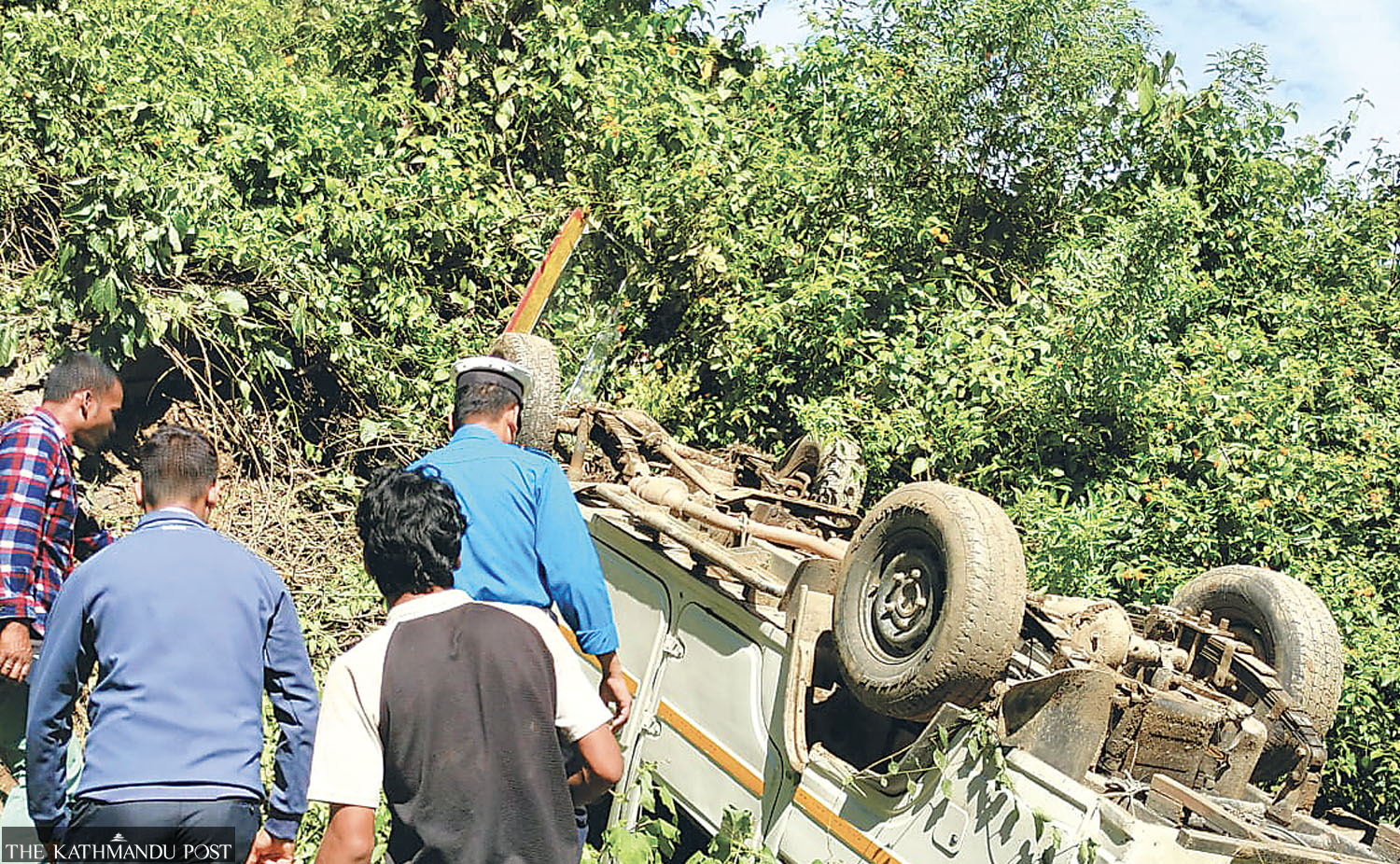
Surkhet, Oct. 12 – On September 29, a tragic accident occurred along the Rapti Highway in Salyan district during the preparation period for Dashain, one of the most significant Hindu festivals. A jeep bound for Dang from Rukum West crashed near Chorkhola in Kapurkot Rural Municipality-3, resulting in the death of four members of a family.
According to the police, the vehicle fell nearly 200 meters down a roadside slope. The victims included Prakash KC, Shashidhar KC, Pabi KC, and Bina KC from Baphikot Rural Municipality-5 in Rukum West.

“The tragedy has struck right before Dashain. The whole village is in mourning,” said Purna Bahadur KC, a local leader from Baphikot-5. He added that preparations for the festival had already begun, with many people returning from outside to celebrate. However, the KC family’s Dashain ended before it could begin, leaving the community devastated.
Karnali, the country’s remotest province, has witnessed a significant number of road crashes during the Dashain period this year. According to the Nepal Police’s Highway Safety and Traffic Management Office, there have been 51 road accidents, resulting in nine deaths and 123 injuries. In the first three months of the current fiscal year, the province recorded 216 accidents, leading to 24 deaths and 494 injuries.
Festival seasons are known to see the highest number of traffic accidents each year. During the month-long period between Dashain and Tihar, there were 97 traffic accidents in the last fiscal year of 2024-25 and 104 in the previous fiscal year of 2023-24. Over the past three fiscal years, 83 people have lost their lives in crashes that occurred during these two major festivals.
Factors Contributing to Increased Accidents
Senior Superintendent of Police Bhawesh Rimal, chief of the Highway Safety and Traffic Management Office, explained that the surge in vehicle movement and passenger flow during festivals leads to an increase in accidents. “Accidents mainly occur due to drivers’ negligence, poor road conditions, alcohol consumption, mechanical failures, and over speeding,” he said.
To address the issue, police launched a special campaign this year, intensifying highway checks, patrols, and radar monitoring. Quick Response Teams were deployed to accident-prone areas, and mobile patrols were increased. Additionally, 43 passenger assistance booths were set up across the province to help travelers avoid fraud and ensure safer journeys.
Despite these efforts, traveling in Karnali during festivals remains a source of anxiety for many families. The narrow and rugged highways pose life-threatening challenges, with landslides often blocking the way. For instance, the Karnali Corridor, Bheri Corridor, Rapti Highway, Mid-Hill Highway, and Karnali Highway have seen frequent landslides, leaving many passengers stranded on their way home for Dashain.
Difficult Travel Conditions and Risky Journeys
Travelers often face dangerous conditions while navigating the roads. “Without bridges over the rivers, we have to get off the vehicles, cross suspension bridges on foot, and then find another vehicle on the other side,” said Dinesh Budha, who was returning to Surkhet through Bheri Corridor after celebrating Dashain at his residence in Thulibheri Municipality-3 of Dolpa. He described the journey as relying only on luck, with narrow roads, overcrowded vehicles, and high speeds making the travel feel like gambling with life.
The situation on the Rapti Highway is no better, with most blacktopped sections having peeled off. “It takes the whole day to cover just 147 kilometers from Rukum West to Dang,” said Bhola Prasad KC, a trader from Musikot Municipality-3. He noted that the journey is full of fear, with landslides posing a constant threat. “Even a short rain can bring down large boulders. We often get stuck on the road for hours.”
The Mid-Hill Highway is relatively better because it is wider and mostly blacktopped. However, the Karnali Highway, which connects Surkhet with Jumla, remains in the worst condition, having remained closed for 39 days this monsoon alone.
Ongoing Challenges and Limited Resources
According to police, multiple landslides sometimes hit the same section up to five times in a single day, leaving travelers stranded for long periods. Ashish Devkota of Khalanga in Jumla described the situation: “The roads are narrow and most of the blacktop has worn away. At any time, landslides can fall from above.” He also mentioned that old vehicles are often crammed with too many passengers, adding to the risk.
The Jumla Division Road Office has identified several high-risk locations along the Karnali Highway, including Daikhola in Dailekh, Gaganekhola, Hulma, Serighat, Sunarkhola, Galli, Molpha, Sherabada, Takulla, Bhaisingauda, Timure, Galje, Ranchuli, and Dhanada in Kalikot.
“Sometimes we clear a landslide and reopen the road, only to get reports of another one an hour or two later,” said Dipendra Kumar Chaudhary, chief of the division office. He explained that the terrain is steep, the soil is weak, and excessive blasting during road construction has worsened the risk. The office lacks funds for permanent repairs and can only conduct minor maintenance.
Persistent Issues Despite Investments
The highway was first blacktopped in 2015 under the federal government’s Road Sector Development Project with World Bank funding of Rs1 billion. According to the Surkhet and Jumla Division Road Offices, around Rs700 million more has been spent in the past three years alone—yet nearly 80 percent of the blacktop has already eroded.
“When it rains, the highway turns muddy; when it’s dry, it’s covered in dust,” said driver Purna Bahadur Budhthapa, who has been driving on the Karnali Highway for five years. He described the road as being only about five meters wide in many places, forcing vehicles to reverse to let others pass.
Karnali Province Police Chief Deputy Inspector General of Nepal Police Madhav Shrestha acknowledged the challenges posed by the poor road conditions. “Old vehicles, overloading, and over speeding are major causes of rising accidents,” he said. “Given Karnali’s difficult terrain and the deteriorating condition of its highways, preventing road accidents is a constant challenge.”
Despite repeated investments and promises of upgrades, travel in Karnali during the festive season remains a perilous journey—where a short trip home can quickly turn into a test of endurance, patience, and luck.