



Understanding the Mystery of Dark Matter
Dark matter, an enigmatic component of the universe, constitutes more than a quarter of its total mass. Despite its significant presence, it has remained elusive to scientists for decades. Unlike ordinary matter, dark matter does not emit, absorb, or reflect light, making it nearly invisible to our telescopes. However, recent research from Johns Hopkins University suggests that scientists may have found compelling evidence pointing to the existence of dark matter.
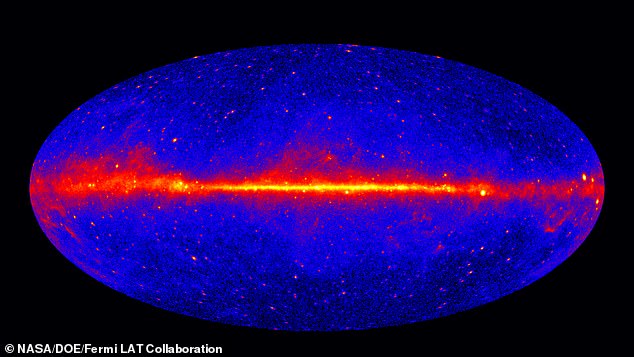
When dark matter particles collide, they produce gamma-ray radiation. This phenomenon has led researchers to believe that the mysterious gamma-ray glow observed at the center of our galaxy could be a sign of dark matter’s location. If confirmed, this discovery could mark the first concrete proof of dark matter’s existence.

Professor Joseph Silk, co-author of the study, emphasized the importance of dark matter in the universe: “Dark matter dominates the universe and holds galaxies together. It’s extremely consequential, and we’re desperately thinking all the time of ideas as to how we could detect it. Gamma rays, and specifically the excess light we’re observing at the centre of our galaxy, could be our first clue.”
The Role of Gamma Rays in Detecting Dark Matter
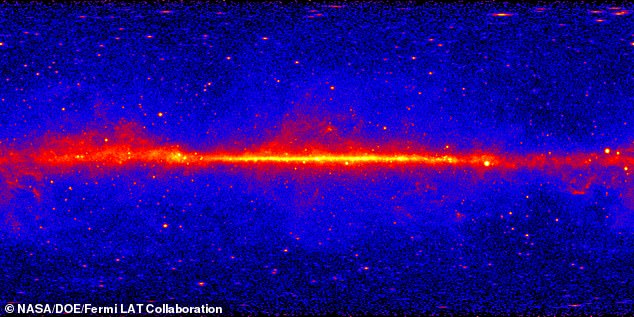
Dark matter is a type of particle that accounts for a large portion of the missing mass in most galaxies. While its gravitational effects can be observed, it does not emit any detectable energy. Since 2008, NASA’s Fermi satellite has been mapping the Milky Way using gamma rays. Scientists noticed a diffuse glow of gamma radiation at the galaxy’s center, which did not originate from any known source.
This unusual glow sparked two competing theories: one suggesting it was caused by spinning cores of dying stars, and the other attributing it to colliding dark matter particles. Determining which explanation is correct has proven challenging.
What Is Dark Matter?
Dark matter outweighs visible matter by a ratio of approximately six to one, making up about 27% of the universe. Unlike normal matter, it does not interact with the electromagnetic force, meaning it does not absorb, reflect, or emit light. This makes it extremely difficult to detect directly. Instead, scientists infer its existence through the gravitational effects it exerts on visible matter.
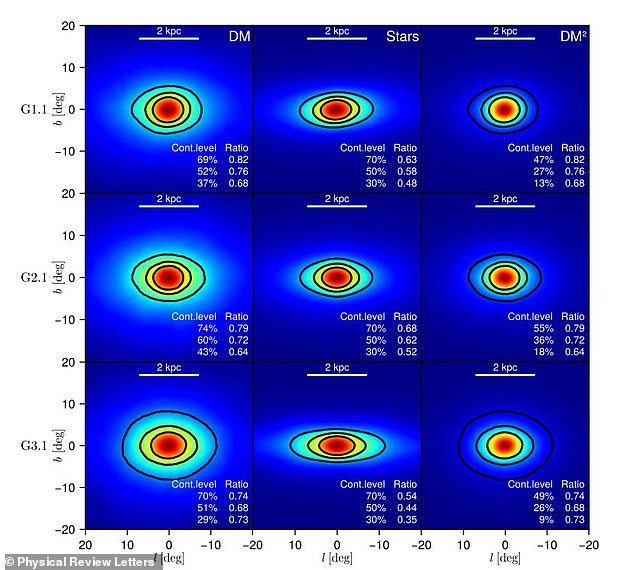
In their study published in Physical Review Letters, researchers used supercomputers to create a map of where dark matter should be located in the galaxy. Their approach took into account how the Milky Way formed, noting that the galaxy originated from a vast cloud of dark matter. As ordinary matter cooled and fell into the central regions, it dragged along some dark matter.
Over billions of years, dark matter from other systems gravitated toward the dense galactic core, increasing the number of collisions. When Professor Silk compared these simulations with real data from Fermi, he found a match between predictions and observations.
The Future of Dark Matter Research
Although this discovery is not yet definitive proof of dark matter, it raises the possibility that the gamma-ray glow is indeed coming from dark matter. Professor Silk noted that dark matter fits the gamma-ray data at least as well as the alternative neutron star hypothesis.
“Our key new result is that dark matter fits the gamma ray data at least as well as the rival neutron star hypothesis,” said Professor Silk. “We have increased the odds that dark matter has been indirectly detected.”
It is still possible that the gamma-ray glow is produced by spinning neutron stars. However, Professor Silk hopes that the soon-to-be-constructed Cherenkov Telescope Array in Chile will help settle the debate. This powerful telescope will have the sensitivity to distinguish between gamma rays from dark matter and those from neutron stars.
Alternatively, the telescope could scan nearby dwarf galaxies, which are believed to be composed mostly of dark matter. Detecting the same signal observed by Fermi at the galactic center would confirm the dark matter hypothesis.
Ongoing Questions and Discoveries
As research continues, many questions remain about the nature of dark matter and its role in the universe. Have scientists uncovered the universe’s “missing matter” in a colossal filament stretching millions of light-years? What groundbreaking cosmic revelations await from the latest simulations tackling the universe’s most enigmatic dark matter? Could the universe be hiding secret antimatter galaxies just out of sight?
What groundbreaking discoveries lie in the largest 3D cosmic map, revealing secrets of dark matter and dark energy? Could the universe’s fundamental forces hold the breathtaking secret behind what we once believed was dark energy? These questions continue to drive scientific exploration and discovery.

