



The Persistent Thirst: Billions Spent, Yet Safe Water Remains a Mirage for Many Lagos Residents
Despite significant financial investment from the Lagos State Government aimed at improving water provision, a substantial portion of the populace continues to rely on wells, boreholes, and commercially packaged water for their daily needs. This investigative report delves into the systemic failures within the public water infrastructure and highlights the urgent interventions required to ensure equitable access to safe drinking water for all.
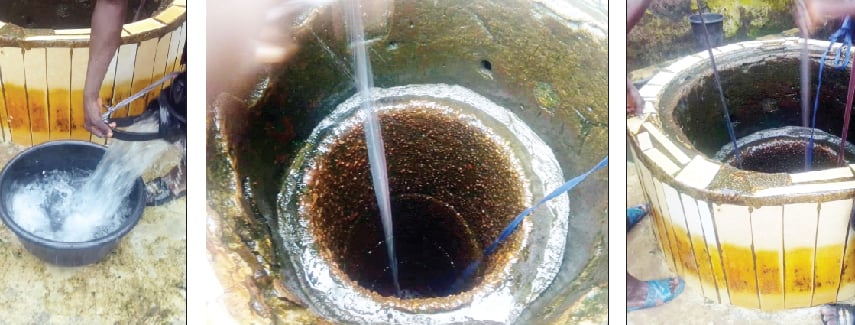
The early morning of November 12, 2025, in Owode-Orile was shrouded in a dense fog, a common sight in the area. Through the mist, a woman’s silhouette gradually took shape. It was Bola Thomas, a mother in her mid-thirties, her baby secured to her back, methodically drawing water from a communal well. She was one of at least seven residents waiting their turn, a daily ritual for many.

“This is nothing compared to the struggle we endure every day just to get water into our homes,” Thomas shared, underscoring the perpetual challenge faced by the community. For countless residents, this well has become their sole dependable water source. Its significance is amplified by its location near the bustling Mile 12 market, a major hub for commodities in Lagos. The modest well caters to over seven neighbouring communities, including Ojajini, Ayenuwa, I Don’t Care Street, Adekunle, Balogun, and Ladipo, as well as sections of Mile 12 itself. This scenario is particularly striking given Lagos’s geographical position, surrounded by water, yet grappling with a fundamental lack of access to potable water.
A Disconnect Between Investment and Impact
Lagos, recognized as the fifth most desirable African city for living, working, and investment according to the Brand Finance City Index 2023, and projecting a substantial N4 trillion budget for 2026, paradoxically sees a large segment of its population dependent on wells, boreholes, and sachet or bottled water. Over the past six years, the Lagos State Government has allocated billions of naira towards water provision initiatives. However, the tangible impact on the daily lives of residents remains minimal, with many still relying on self-sourced water.
Government expenditures paint a picture of significant financial commitment:
* 2020: N5.891 billion allocated for capital expenditure on waterworks.
* 2021: N1.950 billion earmarked for the advancement of Adiyan Waterworks Phase II and the rehabilitation of mini waterworks across the state. The budget also included provisions for “improvement of water reticulation and procurement of water chemicals.”
* 2022: Capital expenditure exceeded N2.510 billion, with total spending reaching N5.741 billion.
* 2023: N1.238 billion allocated for potable water provision.
* 2024: N1.959 billion allocated.
* 2025: A substantial N53.386 billion budgeted for water supply.
Despite these considerable sums, totalling over N66.934 billion in just six years, the reality on the ground is a stark contrast. Residents continue to depend on private boreholes, often unhygienic wells, and sachet or bottled water, indicating a significant disconnect between public spending and the delivery of functional water services to households.
The Global Context: SDG 6 and Nigeria’s Water Challenges
The United Nations’ Sustainable Development Goal 6 (SDG 6) champions universal access to safe water, sanitation, and hygiene as cornerstones of public health and human well-being. Globally, water demand is escalating due to population growth, urbanization, and increasing agricultural, industrial, and energy needs. The UN reports that water stress affects approximately 18% of the global population, with one in ten individuals living under high or critical water stress. Climate change is predicted to exacerbate this scarcity further. Achieving SDG 6 by 2030 necessitates substantial investments in infrastructure, sanitation, ecosystem protection, hygiene education, and efficient water use.
In Nigeria, the 2021 Water, Sanitation and Hygiene National Outcome Routine Mapping (WASHNORM) Survey Report highlights the prevalent reliance on alternative water sources. Tubewells and boreholes serve 37% of the population, followed by unprotected dug wells (12%) and protected dug wells and surface water (each 11%). In the South-West region, sachet water emerges as a primary source for a significant portion of residents, particularly in urban and wealthier households. Alarmingly, the report estimates that 34% of households in Lagos consume water contaminated with E. coli, underscoring a critical public health risk.
Underperforming Waterworks and Distribution Gaps
Nigeria’s installed waterworks capacity stands at 8,058,150 cubic metres per day, yet its actual operational capacity is a mere 1,975,073 cubic metres – a utilization rate of approximately 25%. For Lagos, aspiring to be a global megacity, this situation is particularly concerning. Major waterworks operate significantly below their installed capacity, forcing millions to seek unsafe alternatives.
- Isheri Oshun Waterworks: With an installed capacity of 16,720 cubic metres per day, it reports zero operational utilization.
- Adiyan Waterworks: Designed to produce 293,480 cubic metres daily, it functions at a mere 4.21% capacity, yielding about 12,342 cubic metres per day.
- Iju Waterworks: The most functional of the three, it operates at 48.19% of its 187,440 cubic metres daily capacity.
Compounding these issues is the severe lack of effective distribution infrastructure. Even when water is produced, it frequently fails to reach the intended households.
The Plight of Communities: One Well, Multiple Communities
In Owode-Orile, elderly residents depend on “Meruwa” (water vendors) as they are unable to access water from deep wells themselves. The cost of this necessity is steep; a single gallon can range from N200 to N300, depending on the proximity to the well and the vendor. This single well serves a multitude of communities, highlighting the scale of the deficit.
Residents also face prolonged periods of power outages, which cripple the operation of private boreholes. Samuel recounted instances of electricity being unavailable for an entire year, and more recently, over five months without power, rendering private water extraction impossible.
Toby Agbede, Chairman of the Owode-Orile Landlords Association, expressed frustration, stating that water scarcity is the paramount issue, overshadowing even the persistent problem of electricity. He lamented the repeated failures of politicians to address the community’s needs, despite promises and surveys during election campaigns. The lack of basic infrastructure like boreholes leaves residents appreciative of even minimal interventions.
Community leader Adebayo Aderibigbe echoed this sentiment, noting that despite identifying as an APC community, electoral promises of boreholes have consistently been unfulfilled.
In I Don’t Care Street, Funmilayo, a 60-year-old resident, revealed that the water from the well is unfit for drinking and is used primarily for laundry. Sachet water is the only option for drinking, with a drum refill costing approximately N2,000. Similar narratives of reliance on private boreholes and the prohibitive cost of water are prevalent in areas like Captain, Abule Egba, Oreofe Close, and Ebun Ayodele. Luoso Emmanuel, CDA Chairman in Ilebukun LCDA, confirmed the absence of public water supply and the reliance on costly private boreholes, some of which provide water unsuitable for consumption.
Expert Analysis and Government Response
Public affairs analyst Kolawole Banwo described Lagos’s water crisis as “hydra-headed,” citing moribund waterworks, an overly centralized system prone to lengthy repair times, and severed pipelines due to road construction. He stated that research indicates “Eighty per cent of Lagos residents depend on self-supply,” questioning the efficacy of government spending. Banwo criticized civil service delays, high levels of non-revenue water (estimated at 40%), and slow procurement processes. He advocated for decentralized, independent water utilities capable of cost recovery and immediate fault rectification.
Philip Jakpor, Executive Director of Renevlyn Development Initiative, warned that the lack of safe water is forcing residents into hazardous practices, including the use of contaminated wells and the sharing of containers for sanitation and water collection, leading to diseases like cholera. He emphasized that the government has a fundamental duty to lay and maintain proper pipeline infrastructure, preventing sewage contamination.
In response, Gbenga Omotoso, the Commissioner for Information and Strategy, acknowledged the challenges but asserted that the government is actively pursuing solutions. He highlighted the Lagos Water Corporation’s tendering process for new projects and the anticipated appointment of contractors. He also pointed to ongoing projects like Adiyan Waterworks Phase II, expected to serve four million residents, and a new waterworks in Agege-Akilo, projected to cater to seven million people.
While the government offers assurances, communities across Lagos continue to voice their urgent plea: when will the essential flow of safe, accessible water finally reach their homes?

