


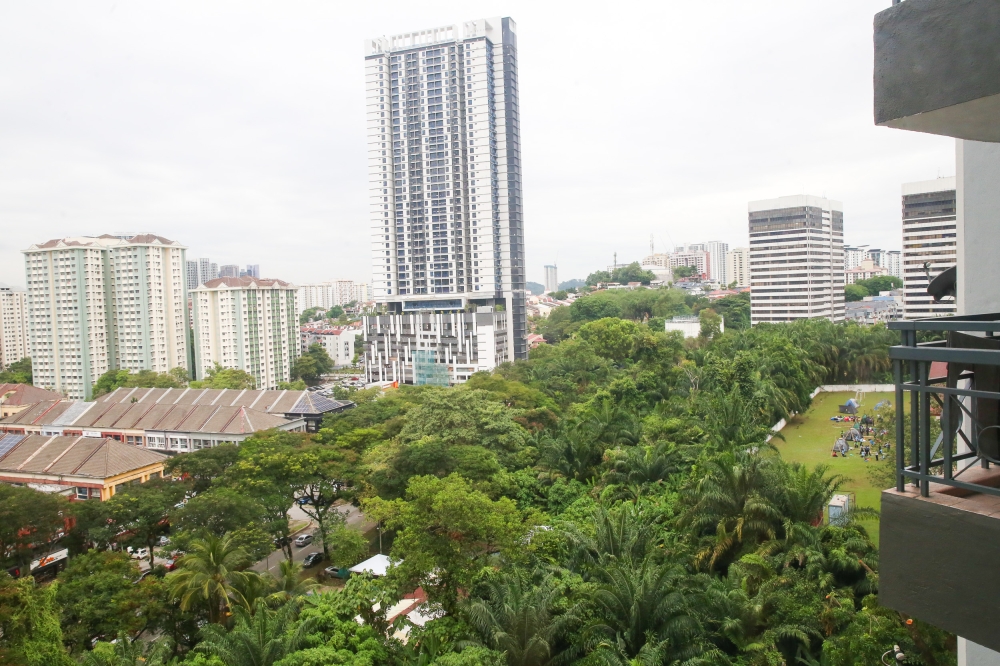

Taman Danau Desa Residents Fight to Preserve Public Spaces
In the heart of Taman Danau Desa, a 500-metre stretch of road is witnessing a growing conflict between residents and developers. Currently, three condominiums have already been built along this short road, housing over 1,300 units. However, the residents are now raising concerns about the potential addition of two more high-rise developments, which could bring an additional 650 units to the area.
Residents argue that this would exacerbate existing traffic problems, as the road is already struggling with congestion. They believe that the two remaining plots of land, originally designated for a playground and a police station, should be restored to their original public use instead of being converted into residential spaces.

The Current State of Jalan 3/109f
Jalan 3/109f is a tree-lined, two-way road in Taman Danau Desa, approximately 450 to 500 metres long. On the left side of the road, there are shoplots, the Danau Idaman condominium, a Shell petrol station, and the under-construction Kensho Residence. This includes Lot 50255, a 0.86-acre land meant for a police station. On the right side, there is a Hindu temple, the 2.11-acre Lot 481440, intended for a playground, and water tanks near the end of the road.
The playground land takes up roughly one-third of the road’s length, equivalent to the size of one football field or 25 parking bays. According to the Protect Taman Desa group, both plots were originally public land but have since been sold to developers and rezoned for residential use, potentially allowing for 320 condominium units per plot.
Preserving the ‘Taman’ Feel
Protect Taman Desa volunteer Dishen Keseva Kumar emphasized the importance of maintaining the neighborhood’s ‘taman’ feel, which refers to its park-like, community-oriented environment. Another volunteer, Lok Shi Shuen, highlighted that weekday traffic on Jalan 3/109f is already overwhelming, and the addition of more condos would only worsen the situation.
“More condos will lead to more cars, and people will start parking on the sides of the road,” she said. “This will make the traffic even worse.”
Lok also pointed out that many residents rely on cars due to limited public transport options, such as Rapid KL’s 650 bus, MRT feeder buses, and DRT van services. She recalled how the area was once more walkable, with her childhood filled with cycling to school and friends’ houses.
Memories of the Playground Land
The playground land had been a central part of the community for over two decades before it was bulldozed on August 31. Lok shared memories of skating on a figure-eight-shaped rink and using the area for walking dogs and training pets. A humanitarian group, Tzu Chi, had also operated a recycling centre and thrift store on the land before being asked to vacate in 2021.
Dishen noted that the land had served as a hub for various community initiatives, including a community garden called Kebun-Kebun Desa. He stressed that without these green spaces, it would be difficult for residents to engage in such projects.
The Significance of the Police Station Land
The land designated for a police station previously housed a food court but is now cleared and fenced up with a “For Rent” sign. Lok mentioned that the nearest police presence is a small pondok in Taman Abadi Indah and the Brickfields police station. James, another volunteer, argued that the Taman Danau Desa land is larger than both and would be ideal for a full-fledged police station.
Alternatively, he suggested that the land should be used for other public amenities like a community hall rather than being developed into another high-rise.
Not Anti-Development, Just Pro-Community
Lok clarified that the group is not against development but is focused on sustainability and preserving public spaces. “It’s not just about quality of life; it affects everyone,” she said. “The only one who wins is the developer.”
James added that the land was a communal space for various activities, from gardening to recreation. “I’m not anti-development, but I believe in protecting what we have,” he said.
Beyond Taman Desa
Lok urged other Kuala Lumpur residents to pay attention to this issue, as similar situations could happen in their areas. James warned that if one playground can be taken away, others could follow. He encouraged more residents to take ownership of their communities and protect their local spaces.


