
South Korea’s Wealthy Population Surges, Outpacing General Households in Asset Growth
The ranks of South Korea’s affluent are expanding, with individuals possessing financial assets exceeding 1 billion Korean won showing a significant increase. Latest estimates suggest that this elite group now numbers over 476,000, representing a notable surge in wealth accumulation across the nation.
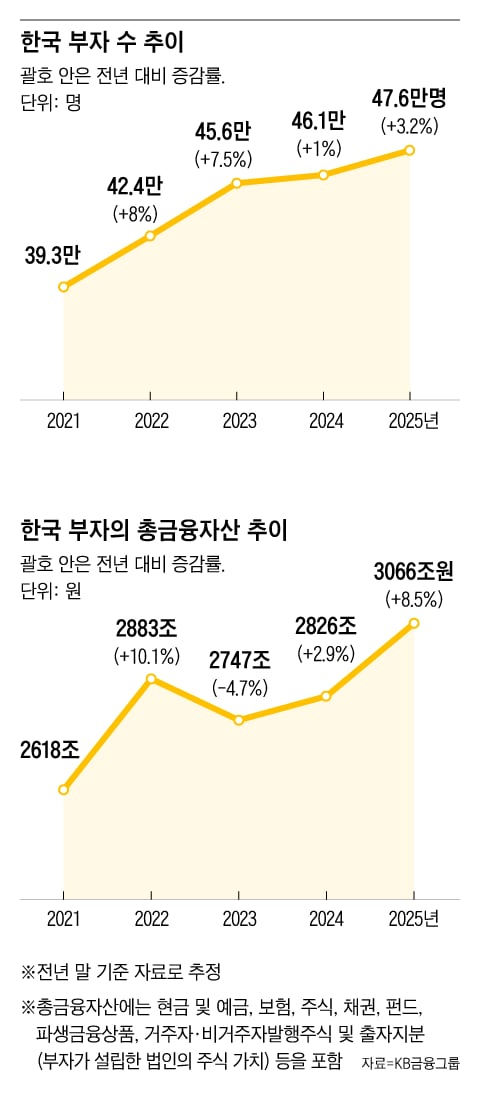
According to the comprehensive ‘2025 Korean Wealth Report’ released by KB Financial Group’s Management Research Institute, the number of “wealthy individuals”—defined as those holding financial assets of 1 billion won or more as of the close of the previous year—reached 476,000. This figure accounts for approximately 0.92% of South Korea’s total population. This represents a substantial 3.2% increase from the preceding year. The growth trajectory is even more striking when viewed over a longer period, with this number more than tripling compared to the 130,000 recorded in 2011.

The aggregate value of financial assets held by South Korea’s wealthy individuals also experienced robust growth. As of the end of last year, this collective wealth amounted to an impressive 3,066 trillion won, marking an 8.5% increase year-on-year. This substantial sum represents a significant portion of the nation’s total household financial assets, which stood at 5,041 trillion won, accounting for 60.8%.
On an individual basis, the average financial assets per wealthy individual climbed to 6.8 billion won. The research institute highlighted a key trend: the growth rate of financial assets among the wealthy (8.5%) significantly outpaced the growth rate of overall household financial assets (4.4%). This disparity underscores a widening gap, with the affluent accumulating wealth at a considerably faster pace than the general population.
The primary drivers behind this accelerated asset growth for the wealthy were identified as:
- Business Income: Contributing a significant 34.5% to asset growth.
- Real Estate Investment Gains: Accounting for 22% of the increase.
- Financial Investment Gains: Making up 16.8% of the growth.
Segmentation of the Affluent: From High-Net-Worth to Ultra-High-Net-Worth
The report further segmented the wealthy population based on their asset holdings:
- Asset Holders (1 billion to 10 billion won): This largest segment comprised 90.8% of the wealthy, totaling 432,000 individuals.
- High-Net-Worth Individuals (10 billion to 30 billion won): This group represented 6.7% of the affluent population, with 32,000 individuals.
- Ultra-High-Net-Worth Individuals (over 30 billion won): The most exclusive tier, making up 2.5% of the wealthy, or 12,000 individuals.
Investment Strategies and Preferences Among the Wealthy
A detailed face-to-face survey conducted between July and August of this year, involving 400 wealthy individuals, provided insights into their asset allocation and investment outlook. On average, their assets were distributed with 54.8% allocated to real estate and 37.1% to financial assets.
A deeper dive into asset composition revealed the following key holdings:
- Residential Housing: Constituting 31.0% of their assets.
- Liquid Financial Assets (e.g., cash): Making up 12.0%.
- Non-Residential Housing (commercial properties): Accounting for 10.4%.
- Savings and Deposits: Representing 9.7%.
- Buildings and Commercial Properties: Holding 8.7%.
- Stocks: Comprising 7.9%.
For those wealthy individuals actively investing in the stock market, their portfolios were diversified, with an average of 5.8 domestic stock positions and 4.9 overseas stock positions.
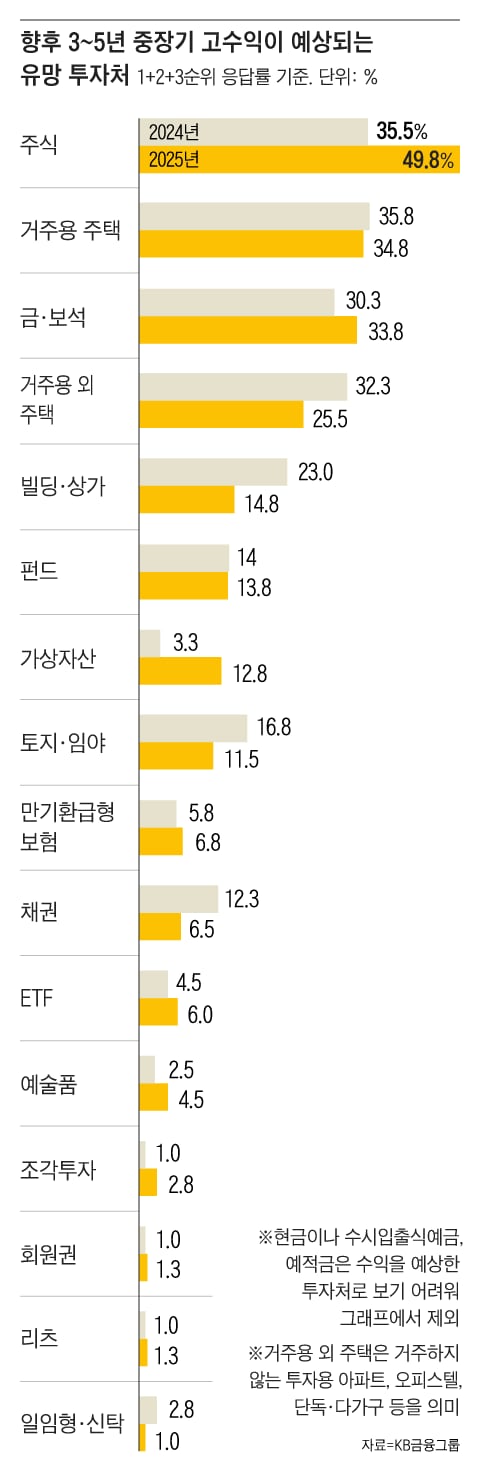
Regarding investment preferences for high returns, stocks emerged as the leading choice for short-term investments (within one year), with 55% of respondents identifying them as the most promising option. This was followed by:
- Gold and Jewelry (38.8%)
- Residential Housing (35.5%)
- Non-Residential Housing (25.5%)
- Funds (14%)
Looking at medium- to long-term investment horizons (3–5 years), stocks maintained their top position, favored by 49.8% of respondents. Residential housing (34.8%) and gold and jewelry (33.8%) were also significant considerations for longer-term wealth building.