


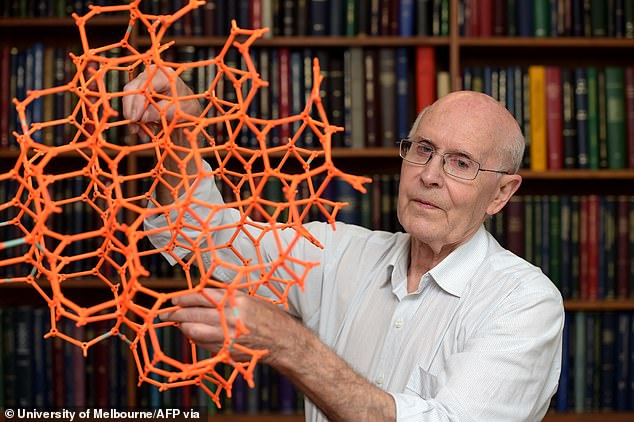

A Groundbreaking Achievement in Chemistry
A professor from the University of Melbourne has made history by winning the Nobel Prize in Chemistry for his revolutionary work that could address some of the most pressing challenges facing humanity. Professor Richard Robson, alongside American-Jordanian Omar Yaghi and Japanese Susumu Kitagawa, was recognized for their development of metal-organic frameworks (MOFs). These structures have the potential to harvest water from desert air, capture carbon dioxide, and separate PFAS from water.
The Nobel committee praised the laureates for creating a new form of molecular architecture. Their discoveries have enabled chemists to build tens of thousands of different MOFs, with some potentially contributing to solving major global issues. Dr. Robson, who is 88 years old, was born in the UK but has been teaching in Australia since 1966. His work has been celebrated as a prime example of blue-sky research that leads to significant breakthroughs.

Emma Johnston, Vice-Chancellor of the University of Melbourne, commended Dr. Robson for his contributions to this groundbreaking work. She emphasized the importance of long-term fundamental research, which allows for the translation of scientific discoveries into practical applications, such as safe hydrogen storage and transfer.
Hans Ellegren, secretary general of the Royal Swedish Academy of Sciences, highlighted the significance of the achievement. He described how chemistry can be used to create entirely new materials with unique properties. This vision aligns with the transformative impact of the trio’s work.
Dr. Robson has received numerous honors throughout his career. In 2022, he was elected a Fellow of the Royal Society, and in 2024, the University of Melbourne established a professorial chair in his name. His early work in 1989 involved testing the properties of atoms using copper ions. The resulting structure formed a well-ordered, spacious crystal, resembling a diamond filled with countless cavities.
However, the molecular construction was initially unstable. It was Kitagawa and Yaghi who provided a firm foundation for the building method. Between 1992 and 2003, they made a series of revolutionary discoveries independently.
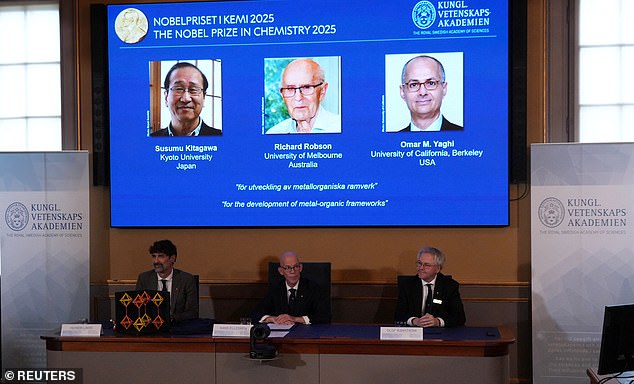
Kitagawa demonstrated that gases could flow in and out of these constructions and predicted that MOFs could be made flexible. Yaghi created a very stable MOF and showed that it could be modified using rational design, giving it new and desirable properties.
Kitagawa expressed his deep honor and delight at the recognition. He shared that he was interviewed by phone during the prize announcement news conference. Yaghi, on the other hand, was astonished and overwhelmed when he received the news. He was in an airport switching flights when the Academy called him to announce the award.
Yaghi’s journey to academia was not easy. Born into a family of refugees in Amman, Jordan, he faced challenging circumstances. He grew up in a small room shared with his family and cattle. His parents had limited education, but school became a refuge for him. According to the Royal Swedish Academy of Sciences, he discovered molecular structures in a book when he was just 10 years old. He even sneaked into the usually locked school library.
He moved to the US at the age of 15 to pursue his studies. Reflecting on his journey, Yaghi said, “So it’s quite a journey,” and credited science for making it possible. He believes that “science is the greatest equalising force in the world.”
The Nobel Prizes in Physics and Medicine were announced earlier this week. The Literature Prize will be awarded on Thursday, followed by the Nobel Peace Prize on Friday. The Economics Prize will conclude the 2025 Nobel season on October 13.
Each Nobel Prize recipient receives a diploma, a gold medal, and a $1.2-million cheque, which is shared among multiple winners in a discipline. This year’s laureates have made a lasting impact on the field of chemistry and beyond.

