
Rising Business Insolvencies in the UK
The recent surge in business insolvencies across the UK has raised concerns among restructuring experts. With 2,000 firms going bankrupt last month alone, there is a growing need for the Chancellor to avoid adding further pressure on British businesses during her upcoming Budget. This comes as the country continues to face economic challenges that have pushed insolvency rates to their highest levels in 30 years since 2023.
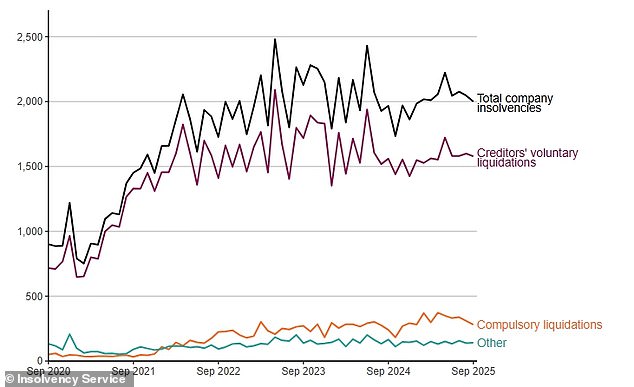
The situation is driven by several factors, including a sharp rise in labor costs, persistently high inflation, and weak consumer confidence. These elements have combined to create an environment where many businesses are struggling to remain viable. According to official figures from the Insolvency Service, published on Friday, there were 2,000 registered company insolvencies in England and Wales in September 2025. This figure is slightly lower than the 2,046 recorded in August but still represents a significant number compared to the 1,967 insolvencies reported in the same period last year.

The breakdown of last month’s insolvencies includes:
- 281 compulsory liquidations
- 1,578 creditors’ voluntary liquidations (CVLs)
- 124 administrations
- 17 company voluntary arrangements
Matthew Richards, joint head of restructuring and insolvency at Azets, highlighted the impact of changes to employer National Insurance, which have increased costs for businesses. He stated that these cost increases have negatively affected profits, pay, and growth. In many cases, businesses have been forced to raise prices as they ran out of options after years of absorbing rising expenses.
Richards also noted that firms across the country are hoping that the November Budget will avoid measures that could further increase costs. If such measures are introduced, he warned, corporate insolvencies are likely to rise even further.
David Hudson, a restructuring advisory partner at FRP, emphasized that the November Budget will be a critical moment in shaping the near-term operating landscape for businesses. He warned that anything that dampens consumer confidence or raises business costs could be the final straw for companies already on the edge. This is particularly true for the hospitality sector, which has been heavily impacted by employer tax rises.
Hudson also referenced forecasts from the International Monetary Fund (IMF), which predict that Britain will face the highest rate of inflation among G7 nations next year. This trend is expected to keep consumer demand low and borrowing costs high, maintaining the pressure on margins and revenue that UK firms are currently experiencing.
The current economic climate presents a challenging environment for businesses, with multiple factors converging to create uncertainty. As the government prepares its Budget, the focus will be on how it addresses these issues and whether it can provide relief to struggling firms.