


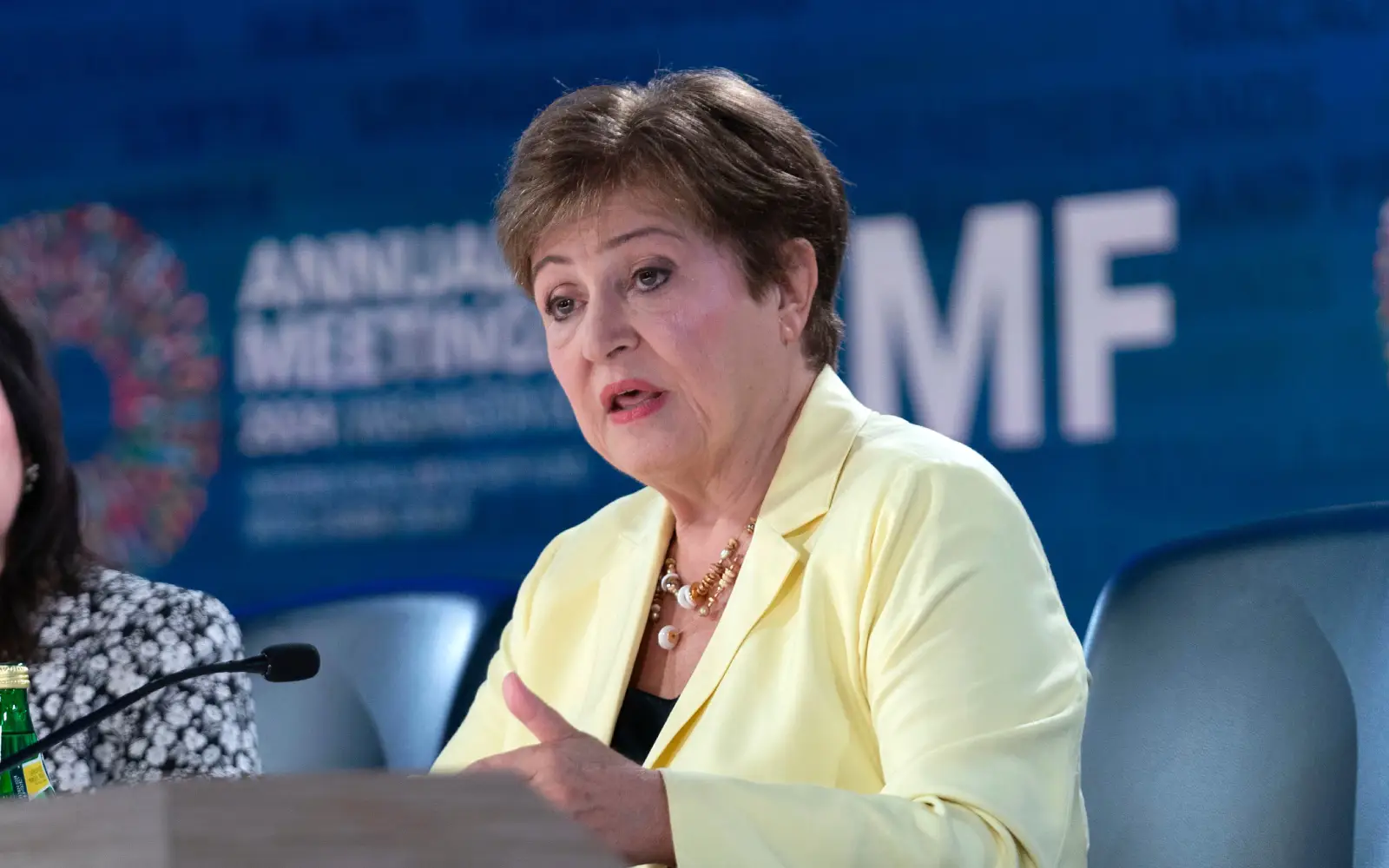

Washington: The global economy is showing signs of improvement, despite ongoing uncertainty and weaker-than-expected growth in the medium term, according to the head of the International Monetary Fund (IMF).
The world economy is performing “better than feared, but worse than we need,” said Kristalina Georgieva, the IMF’s managing director, during a press conference in Washington. She highlighted that the Fund now anticipates only a slight slowdown in global growth this year and next, supported by better-than-expected conditions in the United States and other advanced, emerging market, and developing economies.

Georgieva’s comments were made ahead of the upcoming gathering of finance ministers and central bank governors at the World Bank and IMF in Washington. Trade is expected to be a major topic of discussion, following US President Donald Trump’s decision earlier this year to impose sweeping tariffs on many countries.
Multiple Shocks
“All signs indicate that the global economy has generally withstood acute strains from multiple shocks,” Georgieva stated, pointing to improved policy fundamentals, the adaptability of the private sector, lower-than-expected tariffs, and supportive financial conditions. “The world has avoided a tit-for-tat slide into a trade war—so far,” she added.
She noted that the US tariff rate has decreased from 23% in April to 17.5% today, while the US effective tariff rate of around 10% remains “far above” the rest of the world. However, she warned that the full impact of these tariffs “is still to unfold,” emphasizing that the resilience of the global economy has yet to be “fully tested.”
Despite these challenges, the Fund still expects global growth to remain around 3% over the medium term, consistent with previous forecasts. This is below the average of 3.7% seen before the COVID-19 pandemic.
Changing Global Growth Patterns
“Global growth patterns have been changing over the years, notably with China decelerating steadily while India develops into a key growth engine,” Georgieva said. To boost lackluster growth prospects elsewhere, she urged countries to act swiftly to “durably” lift output, rebuild fiscal buffers, and address “excessive” trade imbalances.
The Fund’s recommendations for policymakers vary by region. In Asia, countries are encouraged to deepen internal trade, strengthen the service sector, and improve access to finance. If implemented correctly, this could increase economic output by as much as 1.8% in the long run, Georgieva said.
On the African continent, countries should promote “business-friendly reforms” and continue efforts to build up the Continental Free Trade Area. This initiative could lift real GDP per capita by “over 10%.” “Gains from this region can be especially large,” she said.
Tough Love for Europe
Georgieva reserved her harshest criticism for Europe, which has struggled with economic growth in recent years, contrasting sharply with the performance of the US. To enhance competition within the bloc, she called on the EU to appoint a new “single market czar” to drive reforms. This move would simplify the EU’s structure and consolidate the power needed to implement the required changes.
These reforms include steps to deepen EU single market integration in financial services and energy. “Complete your project, and catch up with the private sector dynamism of the US,” she said.
For the world’s largest economy, Georgieva urged the Trump administration to address the country’s federal deficit and take steps to incentivize household savings. For China, the world’s second-largest economy, she reiterated the IMF’s ongoing calls for fiscal reforms to boost private consumption and reduce dependence on industrial policy to drive growth.

