



Healthcare Workers’ Strike Intensifies as Unions Reject Calls for Suspension
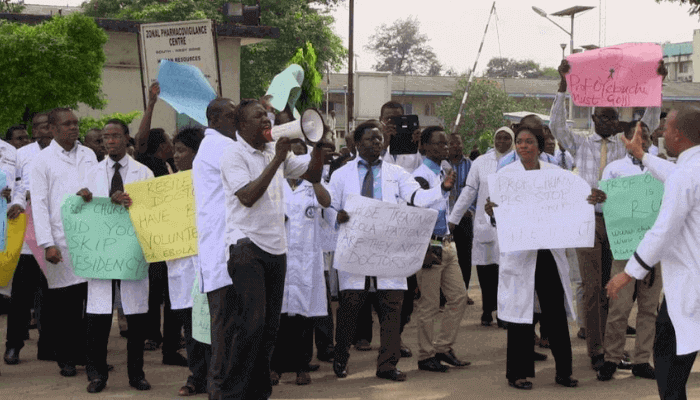
The nationwide strike action initiated by the Joint Health Sector Unions (JOHESU) remains firmly in place, with the organization outrightly rejecting calls to suspend the industrial action. JOHESU leadership has emphasized that any decision regarding the continuation or cessation of the strike must be a collective one, requiring thorough consultation and agreement among its constituent member unions.
Kabiru Minjibir, the President of JOHESU, communicated this stance on Sunday, confirming that the unions had formally informed the Federal Government’s negotiation committee of their inability to call off the strike without first engaging their membership.

Minjibir explained that despite recent discussions and appeals from the government committee urging the unions to suspend the ongoing action, JOHESU maintained its position. Instead, the union resolved to convene an expanded National Executive Council (NEC) meeting. This crucial gathering will serve as the platform for deliberating on the matter and formulating a unified response to the government’s proposals.
“The committee has met and asked us to suspend the strike, but we told them we cannot do that without consulting the unions,” Minjibir stated in a telephone interview. “We have to report back to our members. That is why we are planning an expanded NEC meeting, likely to be held next week, possibly before Christmas. Until then, the strike continues.”
The indefinite nationwide strike, which commenced on November 15, 2025, was launched by JOHESU in collaboration with the Assembly of Healthcare Professional Associations. The core grievances driving this industrial action stem from the Federal Government’s alleged failure to implement the adjusted Consolidated Health Salary Structure (CONHESS) and to adequately address persistent welfare and systemic challenges impacting healthcare workers across the nation.
In response to the escalating strike, President Bola Tinubu took a proactive step by constituting a high-level committee tasked with engaging in negotiations with the striking unions. This committee is expected to provide comprehensive briefings to key government officials. These briefings will include the Ministers of Health and Social Welfare, Finance, and Labour and Employment, as well as the Director-General of the Budget Office of the Federation, detailing the outcomes of their engagements with JOHESU.
Further underscoring the seriousness of the situation, Minjibir also revealed that the leadership of the Nigeria Labour Congress (NLC) met with President Tinubu on Tuesday night. During this high-level meeting, the critical issues affecting JOHESU were formally presented to the President, highlighting the broader implications of the strike for industrial relations in the country.
JOHESU serves as a significant umbrella body, uniting a diverse array of health sector unions. Its membership comprises prominent organizations such as the Medical and Health Workers’ Union of Nigeria, the Nigerian Union of Allied Health Professionals, the Senior Staff Association of Universities, Teaching Hospitals, Research Institutes and Associated Institutions, and the Non-Academic Staff Union of Educational and Associated Institutions. This broad coalition amplifies the collective voice and impact of health workers.
The ongoing strike has undeniably continued to disrupt essential services within public health institutions across the length and breadth of the country. This disruption has inevitably heightened concerns among patients, their families, and a wide spectrum of healthcare stakeholders who rely on the consistent and unimpeded delivery of medical care. The prolonged industrial action poses a significant challenge to the nation’s healthcare system, raising urgent questions about the path to resolution and the restoration of normal services.
The demands of JOHESU are multifaceted and deeply rooted in the desire for improved working conditions and fair remuneration. Key among these are:
- Implementation of the Adjusted Consolidated Health Salary Structure (CONHESS): This has been a long-standing demand, with health workers seeking a salary structure that reflects their professional responsibilities and contributions.
- Addressing Welfare Challenges: This encompasses a range of issues including inadequate hazard allowances, poor working environments, and insufficient provision of essential medical equipment and personal protective gear.
- Resolving Systemic Issues: JOHESU is also advocating for reforms to address what they perceive as systemic inefficiencies and inequities within the healthcare sector that hinder effective service delivery and professional growth.
The government’s formation of a negotiation committee signifies an acknowledgement of the strike’s severity and the need for dialogue. However, the continued refusal of JOHESU to suspend the strike pending further consultation indicates a lack of trust or a perceived inadequacy in the initial government proposals. The upcoming expanded NEC meeting will be a critical juncture, determining the next steps in this protracted industrial dispute. The nation’s healthcare system and its patients remain in a state of anxious anticipation as this standoff continues.

