


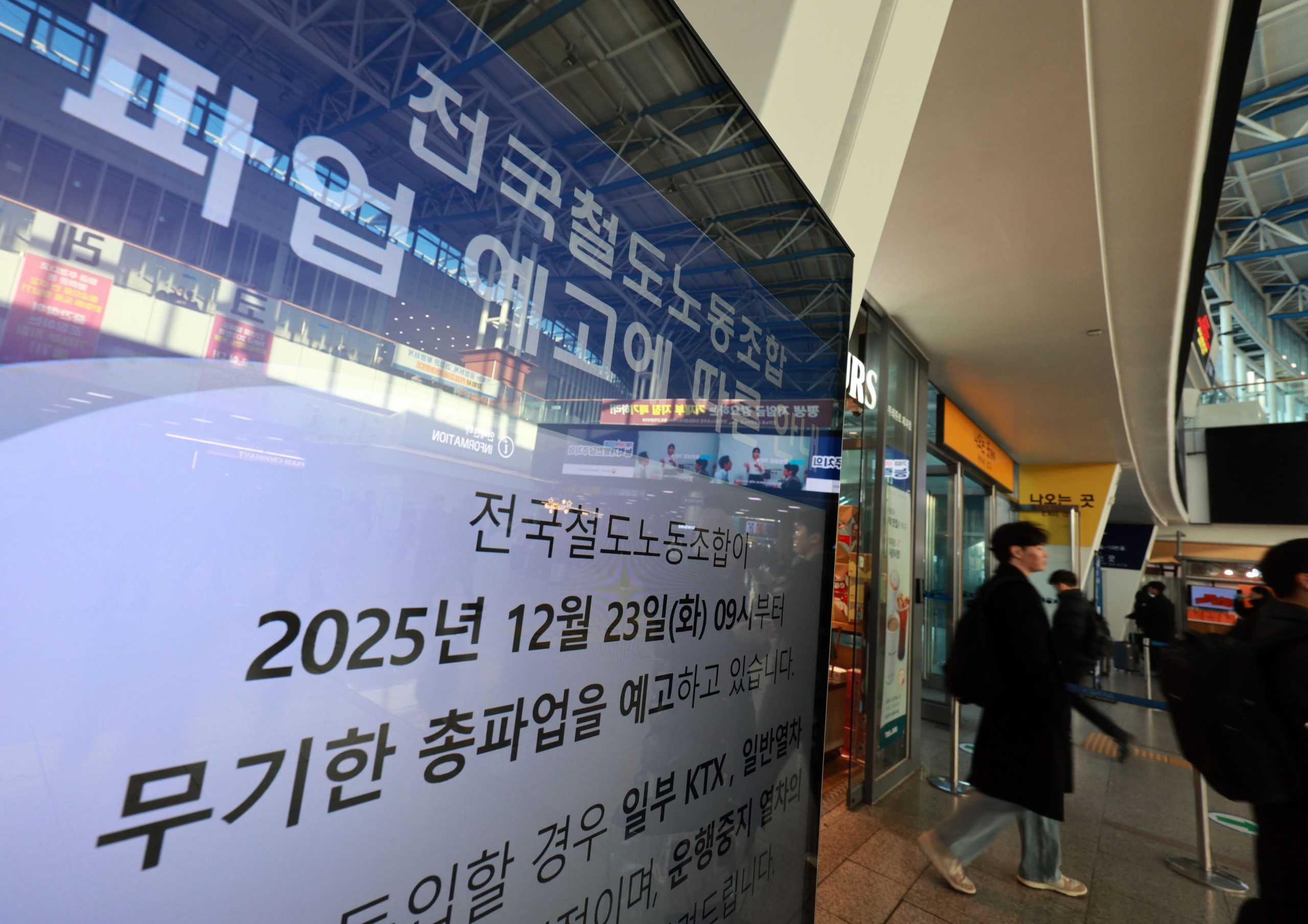

Railway Union Strike Threatens National Transportation Network
A significant labor dispute is poised to disrupt South Korea’s vital railway system, with the nation’s first railway union, KORAIL, announcing a large-scale strike commencing on the 23rd. The union has declared that the anticipated participation of 12,000 members marks the largest turnout in its history. Chairman Kang Geuk has issued a resolute statement, asserting, “We will fight without retreating even an inch, staking the organization’s fate on this battle.”
The potential ramifications of this industrial action are substantial, given the critical nature of railway operations. As a designated essential maintenance service, certain operational levels are mandated to be maintained during a strike. Specifically, KTX high-speed trains are required to operate at a minimum of 56.9%, Saemaeul-ho trains at 59.5%, Mugunghwa-ho trains at 63%, and the Seoul Metropolitan Subway at 63%. KORAIL has outlined plans to deploy replacement personnel with the aim of increasing the operational capacity of the Seoul Metropolitan Subway to 75.4% and KTX services to 66.9% of their normal frequencies.

Despite these contingency measures, KORAIL has cautioned that service disruptions are still likely. A spokesperson for KORAIL indicated that train intervals on several lines, including the Gyeonggang Line, Daegyeong Line, Donghae Line, and Gyeongui-Jungang Line, could be extended from the usual 40 minutes to as much as an hour. To mitigate passenger inconvenience, KORAIL is actively disseminating information regarding suspended train services through individual SMS messages and the KORAIL Talk application. Passengers are strongly advised to “leave home early or use alternative transportation such as buses” to account for anticipated delays.
In an effort to support passengers affected by cancellations, KORAIL has announced that penalty fees for ticket returns or changes due to service suspensions will be waived. Furthermore, passengers holding tickets for trains that are ultimately suspended will receive a full refund without the necessity of submitting a separate refund request.
The Root of the Dispute: Performance-Based Pay Discrepancies
The gravity of this strike extends beyond immediate operational concerns, with the railway industry closely observing the underlying reasons for the union’s action. While the union explicitly cites the issue of “normalizing performance-based pay” as the direct catalyst for the strike, a deeper analysis suggests broader dissatisfaction. Interpretations both within and outside the union point to a perceived inequity in how the Ministry of Economy and Finance, which oversees the disbursement of performance-based pay, applies its policies to affiliated institutions like KOMSCO (Korea Minting, Security Printing & ID Card Operating Corporation) and KORAIL.
The disparity in performance-based pay received by KORAIL compared to other public institutions has a history dating back approximately 15 years. In 2010, the government initiated a comprehensive reform of public institution wage systems. The objective was to establish a direct link between performance-based pay and actual work output, moving away from its prior treatment as a fixed salary component. As part of this reform, public institutions were permitted to increase their bonuses by incorporating them into their base salary structures.
However, KORAIL’s situation diverged due to a delay in submitting the necessary documentation related to wage negotiations and union strikes. The union’s industrial actions and protracted salary talks meant that KORAIL submitted the required paperwork nearly a year after the government’s stipulated deadline. This delay was viewed by the government as a significant transgression, resulting in a penalty. Consequently, KORAIL’s performance-based pay was capped at 80% of its base salary, rather than the full 100% that might have been attainable had the deadlines been met. This historical disadvantage continues to be a central point of contention for the union.

