


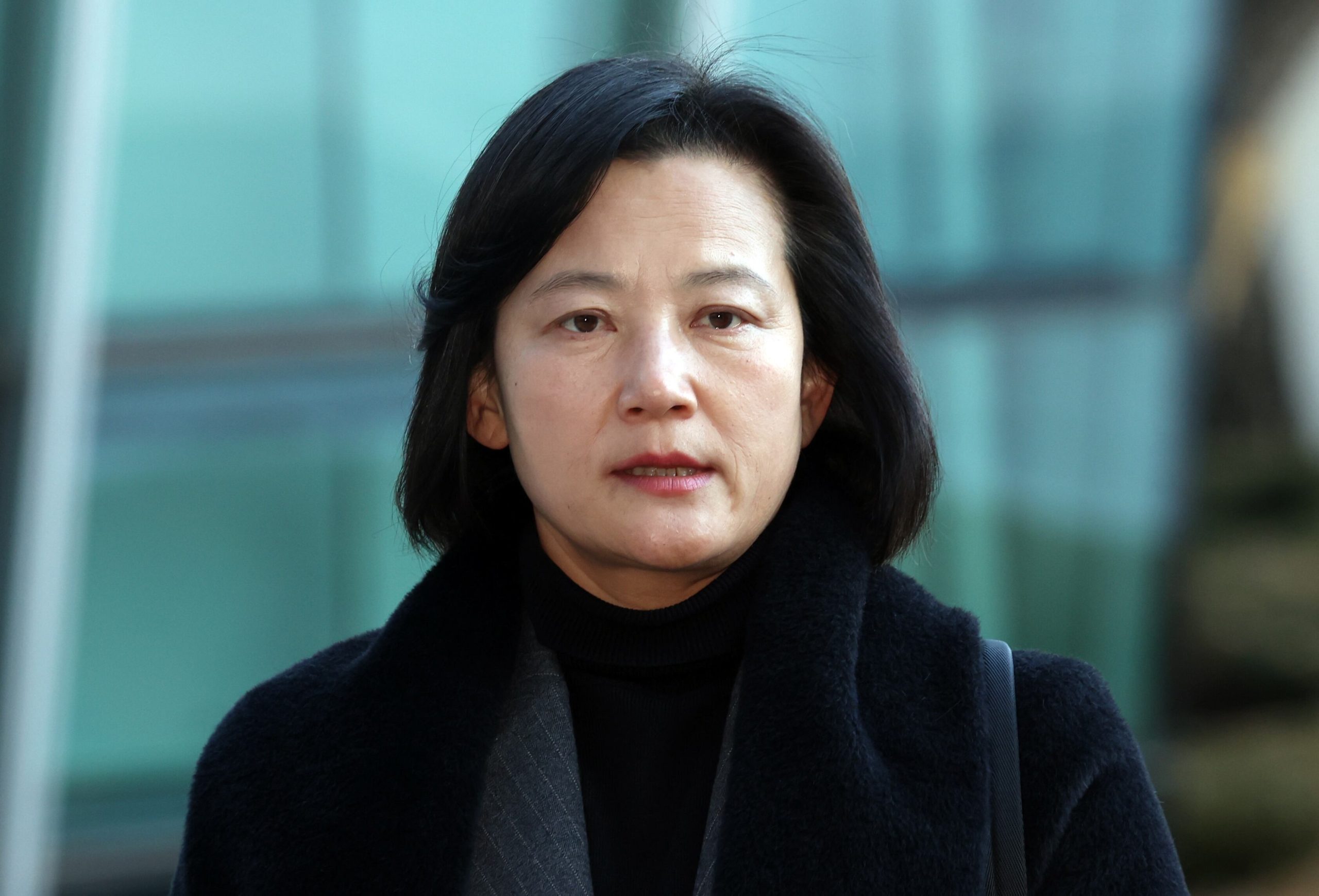

Prosecutor General Challenges Demotion in Landmark Legal Battle
A significant legal confrontation has emerged within the South Korean prosecution service, centering on the controversial reassignment of Prosecutor General Jeong Yu-mi. Effectively demoted from her position at the Supreme Prosecutors’ Office to a prosecutor at the Daejeon High Prosecutors’ Office, Jeong has lodged a formal protest, labeling the personnel decision as “an unprecedented and exceptional measure in history” and seeking an immediate halt to its enforcement. The Ministry of Justice, however, stands firm, asserting that personnel decisions fall squarely within the purview of the appointing authority and that Jeong’s request for a suspension of execution lacks merit.
The legal battle unfolded on the 22nd at the Seoul Administrative Court, where the 5th Administrative Division, presided over by Judge Lee Jeong-won, heard arguments regarding the suspension of execution for Jeong’s lawsuit aimed at nullifying the personnel order. In her plea, Prosecutor General Jeong argued that the reassignment order demonstrably violated existing laws and regulations. She further contended that making such significant personnel decisions based on an individual’s expressed opinions is fundamentally inappropriate.

The catalyst for this drastic personnel shift appears to be Jeong’s recent public criticisms, disseminated through the prosecution’s internal network. These remarks were directed at the prosecution’s leadership concerning the controversial “Daejang-dong appeal abandonment incident.” Specifically, Jeong pointed fingers at Seoul Eastern District Prosecutors’ Office Chief Lim Eun-jeong. In response to these actions, the Ministry of Justice transferred Jeong on the 11th. The Ministry’s justification cited that Jeong’s statements created misinterpretations regarding the prosecution’s political neutrality and fairness. Furthermore, they alleged that her repeated criticisms of internal colleagues, employing inappropriate language, had damaged the organization’s honor and eroded public trust.
Prosecutor General Jeong’s legal team has presented a compelling argument that her reassignment constitutes an illegal demotion. They assert that the position of a researcher at the Ministry of Justice Training Institute is typically occupied by a Supreme Prosecutors’ Office prosecutor of equivalent rank to a prosecutor general. Consequently, assigning her to a lower-tier High Prosecutors’ Office prosecutor role, in their view, is indistinguishable from a disciplinary demotion and thus unlawful.
Ministry of Justice Defends Personnel Action
The Ministry of Justice, in its defense, has characterized Prosecutor General Jeong’s internal posts not as simple expressions of opinion but as actions that contravene the duties of public officials. Their argument hinges on the principle that prosecutors, as public servants, are bound by a duty of obedience. They contend that Jeong’s criticisms were contemptuous and derogatory towards the prosecution leadership and that she leveled false accusations against her fellow prosecutors.
Furthermore, the Ministry disputes Jeong’s assertion of a hierarchical demotion, emphasizing that prosecutors operate under a unified seniority system. This system, they argue, negates any perceived hierarchical distinction between prosecutors at the Supreme Prosecutors’ Office and those at High Prosecutors’ Offices.
To bolster their claim of discretionary authority, the Ministry cited historical precedents where Supreme Prosecutors’ Office prosecutors were indeed appointed to positions within High Prosecutors’ Offices. A legal representative for the Ministry specifically mentioned former High Prosecutors’ Office Chief Hwang Cheol-gyu, who was once appointed as a Seoul High Prosecutors’ Office prosecutor, and a similar instance involving Prosecutor Kwon Tae-ho.
The Ministry also drew a parallel with the judiciary, noting that judges who have held senior positions, such as Presiding Judges at high courts, have also served in local court roles. This analogy, they maintain, demonstrates that such personnel movements are not inherently problematic.
Following the court hearing, Prosecutor General Jeong addressed reporters, underscoring the legal definition of prosecutorial status and positions as being established by law and enforcement decrees. She expressed concern that if the Ministry of Justice’s interpretation of all prosecutors being part of “a single bloc” is accepted, it could pave the way for arbitrary and potentially abusive personnel decisions in the future. The outcome of this legal challenge is anticipated to have significant implications for the internal governance and perceived impartiality of the South Korean prosecution service.

