
The Aftermath of the Supreme Court Destruction
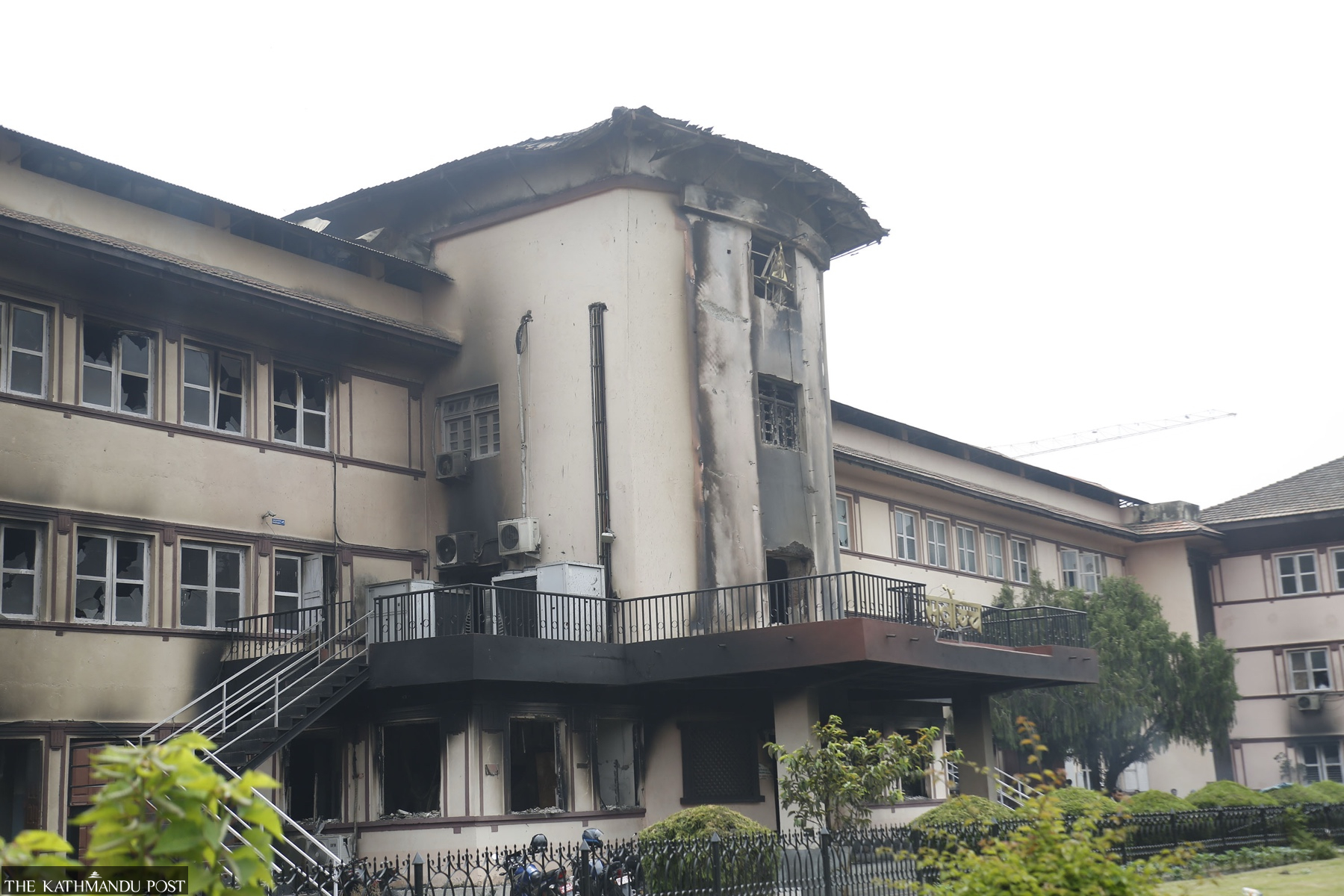
Kathmandu, Oct. 12 – A month has passed since the Supreme Court building was destroyed during a Gen Z-led movement, and there is still no clear timeline for when the country’s top court will resume full operations. Despite efforts to restore normalcy, the damage caused by the incident continues to hinder the court’s functioning.
A week after the arson at the court complex, the judiciary began hearing habeas corpus petitions on September 14 from a makeshift structure on its premises. However, with most case files and offices lost in the fires, the court is unable to conduct other hearings. Man Bahadur Karki, the registrar at the court, stated, “We are very much willing to resume hearings, but it is impossible without the place to house the benches and working space for staff.”

The Gen Z protest that began on September 8 escalated into violence when 19 youths—17 outside the federal parliament at New Baneshwar, and two in Itahari—were killed in police firing on the same day. The following day, protesters not only torched the homes of then-prime minister KP Sharma Oli and several other leaders but also attacked public properties.
According to the Department of Urban Development and Building Construction, as many as 440 buildings of 287 federal offices, including the Supreme Court and its subordinate courts, were destroyed during the violent protests. Fires damaged buildings, infrastructure, important documents, and case files. Karki mentioned that 20,000 of the 24,200 files of running cases were destroyed in the fires, while hundreds of files of already decided cases were also lost. The top court was established in 1956.
Efforts to Recover Lost Files
During a meeting with the Nepal Bar Association and the Attorney General’s Office on Thursday, Chief Justice Prakash Man Singh Raut expressed concern about the delay in justice delivery. He claimed that the court’s information technology section is currently working to recover data. “The court will resume its full services once the data is recovered,” he said.
Court officials have plans to start hearings from a few benches after Tihar in the last week of October. However, a senior official at the court noted, “We can make ambitious claims, but I do not see the possibility of a full-fledged hearing commencing in the next five to six months.” Without case files, conducting hearings remains impossible.
To address this issue, the Supreme Court’s full bench on September 21 decided to prepare a directive to recover destroyed case files. As a result, the Supreme Court issued the Directive on the Recovery and Authentication of Case Files Destroyed Due to Special Circumstances, outlining five methods for recovery:
- First, it will collect copies of documents or records related to cases available with any court or institution.
- Second, it will gather judgments and documents uploaded on the websites of the Supreme Court and other government bodies.
- Third, the court will collect documents in possession of judges and staff obtained during court proceedings.
- Fourth, it will gather documents exchanged electronically between various courts, other government bodies, and judges or court officials.
- Finally, the fifth method allows for the collection of documents through other “appropriate means.”
“Producing 20,000 case files is not a joke,” Karki said. “It will take months.”
Collaboration and Damage Assessment
At Thursday’s meeting, the Nepal Bar Association assured support for recovering the case files and coordinating with lawyers involved in the cases. Karki added that, alongside recovering the case files, a detailed assessment of the infrastructure, material, documentary, and archival damage is ongoing.
In addition to the Supreme Court, 23 lower courts were attacked by protesters on September 9. The Kathmandu District Court, the Special Court, Tulsipur High Court, Biratnagar High Court, and Tanahu District Court suffered significant damage. The Kathmandu District Court alone lost at least half a million files of sub judice and decided cases.