
European Commission Faces Two Confidence Votes
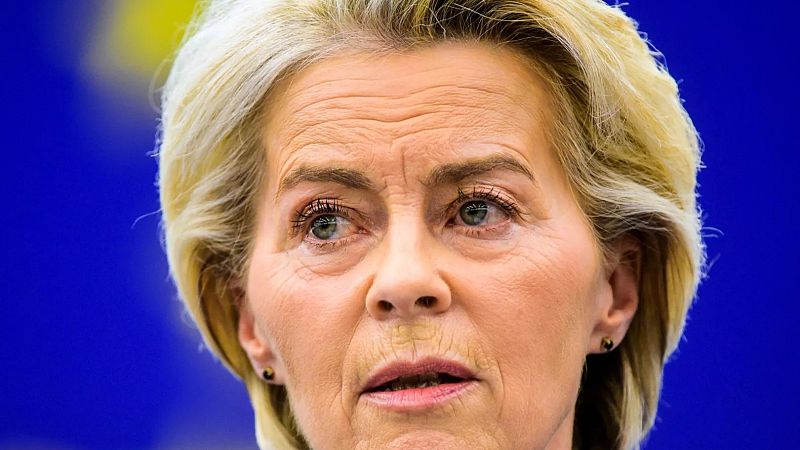
The European Commission, led by Ursula von der Leyen, is set to face two motions of censure on Thursday. This comes just three months after the Commission narrowly survived a similar vote. The votes will take place at noon in Strasbourg, with MEPs voting on each motion one after the other. To pass a motion of censure, at least two-thirds of the votes cast are required, which translates to 360 out of 719 members of the European Parliament.
A successful vote would force the entire European Commission to resign, but it would require a significant number of MEPs to support the motion. The current political landscape and the positions of various groups will play a crucial role in determining the outcome of these votes.

Motions of Censure: Key Issues
The first motion of censure has been tabled by the far-right Patriots for Europe (PfE) group. It focuses on the European Commission’s environmental policies and recent trade agreements with the US and Mercosur countries. The motion argues that these agreements threaten Europe’s farming industry by allowing products that do not meet EU environmental, social, and health standards. This creates unfair competition that puts thousands of European farmers and livestock producers at risk. The motion also criticises the Commission’s handling of irregular migration and an alleged lack of transparency.
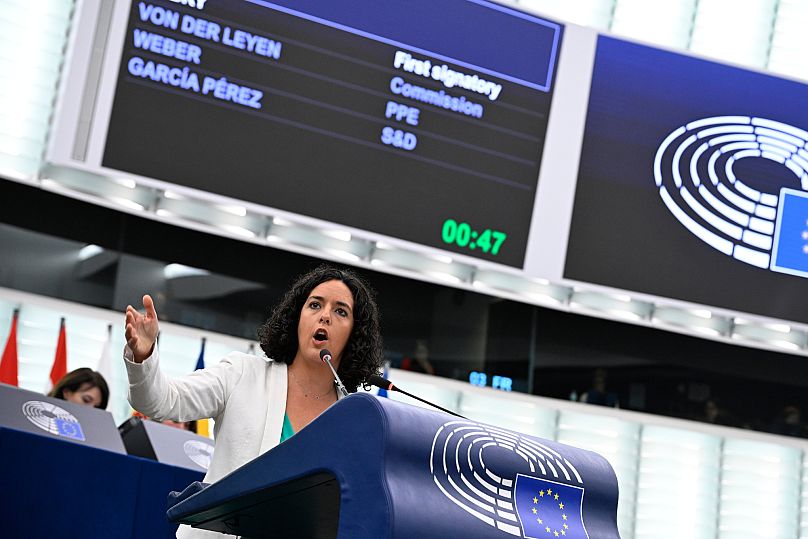
The Left group has also submitted a motion of censure, which shares some common points with the PfE motion. Both address the EU-Mercosur free trade deal, the EU-US trade deal, and the Commission’s alleged lack of transparency. However, The Left’s motion goes further, condemning the Commission’s failure to address the climate crisis and the social crisis across Europe. It also criticises the Commission’s stance on the Israel-Hamas war, calling it a “failure to act in response to the Israeli government’s brutal military assaults and systematic violations of international and humanitarian law in Gaza.”
During the joint debate, PfE President Jordan Bardella and The Left co-chair Manon Aubry voiced their criticisms in an effort to convince their colleagues to support the respective motions.
Von der Leyen’s Response
Von der Leyen responded to the confidence votes with a more conciliatory tone compared to her previous intervention in July, where she accused the promoters of the motion of censure of being under the control of “their puppet masters in Russia or elsewhere.” This time, she focused on the need to deliver for Europeans, stating, “The point I am making is that we need to focus on what really matters, which is to deliver for Europeans.”
Voting Trends Among Political Groups
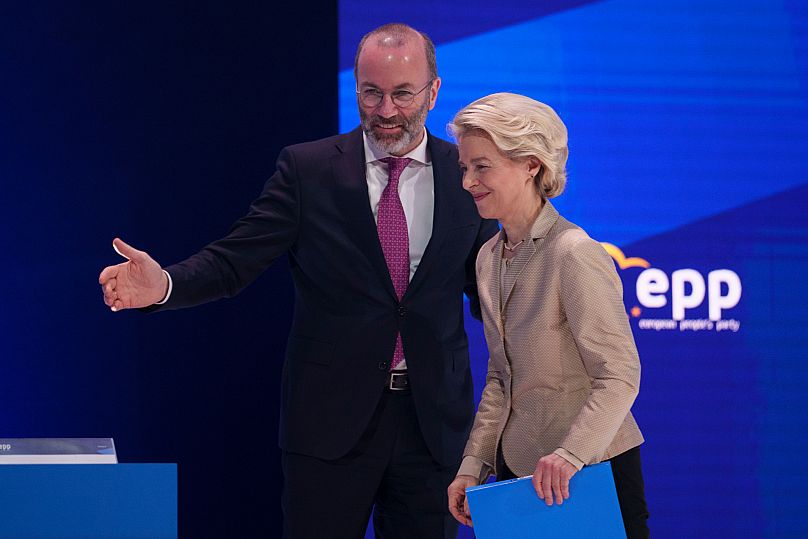
After two days of meetings and internal discussions, most political groups have adopted a standard line on the two motions of censure. The European People’s Party (EPP), which includes 188 MEPs, is fully aligned behind the Commission and will vote against both motions. EPP’s chair, Manfred Weber, described the confidence votes as “a little bit ridiculous” and a “simple propaganda tool” for their promoters.
The Socialists and Democrats (S&D) group, with 136 MEPs, will also not support the two no-confidence attempts. However, some S&D MEPs may adopt a different posture between the two votes, potentially voting against the PfE motion while abstaining or not showing up for the vote on The Left’s motion.
Renew Europe, consisting of 75 MEPs, is also clearly against the two motions of censure. Its chair, Valérie Hayer, labelled the parties that proposed the motions as “trolls.” The group’s spokesperson, Vincent Stuer, stated, “It is pretty clear that we are not playing that game.”
Right and Left Wing Voting Patterns
On the right wing of the Parliament, the Patriots for Europe (PfE) group, with 84 MEPs, is expected to vote for its own motion and likely support the one from The Left. Italian MEP Roberto Vannacci mentioned that his group will join the effort to topple the Commission, despite not agreeing with the wording on Gaza contained in The Left’s motion.
The European Conservatives and Reformists (ECR) group, with 79 MEPs, has left it up to national delegations to decide how they will vote. Internal sources suggest that the group may split again, similar to the last confidence vote.

The Europe of Sovereign Nations group (ESN), with 27 MEPs, is likely to support the motions. An internal source indicated that many of its MEPs will vote in favor of the motion tabled by the Patriots, and some may also support The Left’s motion.
Leftist groups within the Parliament are also expected to show some divisions. The Greens/EFA group (53 MEPs) is oriented to vote against both motions. However, some of its MEPs from Spain and Italy may support The Left’s initiative.
The Left Group’s Dilemma
The Left group, with 46 MEPs, faces a sharp dilemma. While the group remains committed to toppling the Commission, it does not want to join forces with the far right. Despite The Left’s chair, Manon Aubry, promising not to vote for the PfE motion, some members like the Italian Five Star Movement may support it.
The threshold needed to topple the Commission is unlikely to be reached. However, any increase in the number of MEPs supporting the motion would represent a symbolic victory for the proponents. Conversely, any decrease in the number of MEPs opposing the motion would signal a worrying trend for von der Leyen’s approval rate in the Parliament.