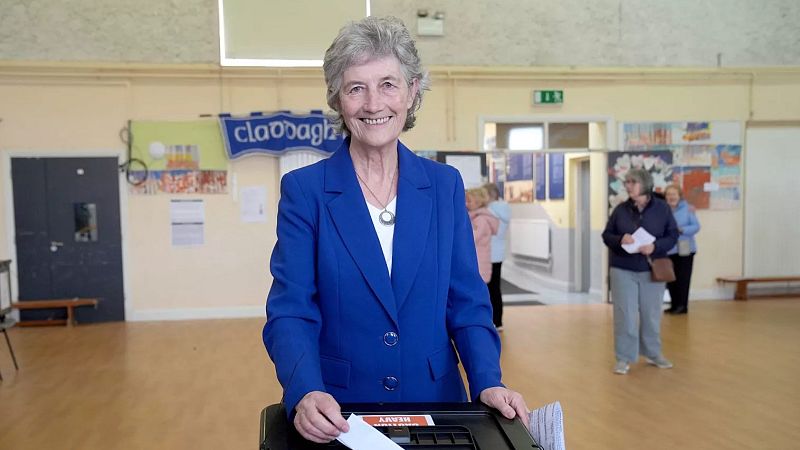

A Landmark Victory for Catherine Connolly
Catherine Connolly, a left-wing independent candidate, has made history by securing a landslide victory in Ireland’s presidential election. Her centre-right opponent, Heather Humphreys, officially conceded defeat on Saturday afternoon, marking the end of a closely watched contest.
Humphreys extended her congratulations to Connolly, stating, “Catherine will be a President for all of us, and she will be my President, and I really would like to wish her all the very very best.” This gesture highlighted the bipartisan nature of the election, despite the ideological differences between the two candidates.

The counting process was ongoing on Saturday, with early results showing a significant lead for Connolly. She is set to succeed outgoing president Michael D. Higgins, who has served as Ireland’s head of state since 2011. The transition marks a pivotal moment in Irish politics, as Connolly becomes the first left-wing candidate to win the presidency in recent years.
Support from Left-Leaning Parties
Connolly received strong backing from several left-leaning parties, including Sinn Féin, the Labour Party, the Greens, and the Social Democrats. These groups have long advocated for progressive policies and social justice, aligning with Connolly’s platform. As an independent lawmaker since 2016, she has built a reputation as a vocal advocate for the people of Ireland.
At 68 years old, Connolly is a fluent Irish speaker from Galway in the west of Ireland. She has pledged to be a voice for all citizens and to promote peace both domestically and internationally. Her background as a former barrister has given her a deep understanding of legal and political matters, which she has used to challenge established norms.
Criticisms and Controversies
Connolly has been a vocal critic of the European Union and the United States. She has opposed the EU’s plans to increase military spending, arguing that such measures divert resources from more pressing social issues. Additionally, she has spoken out against Israel’s actions in Gaza, reflecting her commitment to human rights and international solidarity.
Her stance on these issues resonated with many young voters, particularly those concerned about the housing crisis. Connolly attributed the crisis to government policy, which helped her gain support among a demographic that often feels overlooked in mainstream politics.
Expert Perspectives
Professor Tobias Lock, a specialist in EU law at the University of Maynooth, provided insight into the implications of Connolly’s victory. He noted that her role as president will not significantly impact the relationship between Dublin and Brussels. “She won’t be involved in day-to-day politics obviously, it is not part of her role and she won’t be involved in the Irish presidency of the EU either,” he said.
Lock also highlighted that while Connolly voted against the Lisbon Treaty in 2009, she maintains that she is pro-European but envisions a different kind of Europe—one that is more socially focused. He found the campaign somewhat unusual, as candidates were asked about issues they had no direct influence over, such as housing and defense.
Election Dynamics
Initially, three candidates were in the running for Ireland’s tenth presidency. However, Jim Gavin, the candidate representing Fianna Fáil under Prime Minister Micheál Martin, withdrew from the race due to a financial dispute dating back to 2009. Despite his withdrawal, his name remained on the ballot paper, raising questions about the integrity of the process.
Irish presidents serve as ambassadors for the country on the global stage, hosting visiting heads of state and performing constitutional duties. While their role is largely ceremonial, it carries significant symbolic weight. Presidents do not hold the power to shape laws or policies, but their influence can extend to shaping public discourse and national identity.
Conclusion
Catherine Connolly’s victory represents a shift in Ireland’s political landscape. As the first left-wing president in recent memory, she brings a unique perspective to the role, one that emphasizes social justice, international cooperation, and a critical view of traditional power structures. Her win is a testament to the evolving priorities of the Irish electorate and the growing demand for leaders who reflect their values.