
Record-Breaking Day in Global Financial Markets
On a day that will be remembered in financial history, stock markets across the globe experienced significant gains, with gold prices surging past the $4,000 mark for the first time. Investors remained undeterred by warnings of potential market corrections, showcasing a strong appetite for risk.
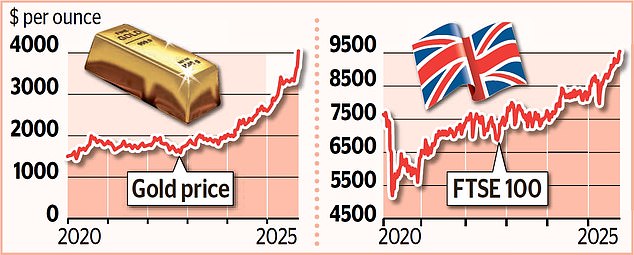
The FTSE 100, a key indicator of the UK’s financial health, climbed 0.7 per cent, or 65.29 points, reaching an all-time high of 9,548.87. This was accompanied by a surge in the price of gold, which hit $4,059 per ounce. Silver also reached a new record high, nearing $50 per ounce.

This bullish trend was not limited to the UK. The Paris stock market made a remarkable comeback following the collapse of the French government, reflecting a global shift in investor sentiment. Despite these positive developments, both the Bank of England and the International Monetary Fund (IMF) issued warnings about the potential for a sharp market correction.
The Bank of England highlighted that the risk of a sudden correction has increased, warning that the impact on the UK economy could be “material.” Similarly, IMF Managing Director Kristalina Georgieva expressed concerns that a sharp correction could negatively affect global growth and expose underlying vulnerabilities.

Despite these warnings, the mood on trading floors remained optimistic. Chris Beauchamp, chief market analyst at IG, noted that the warning about a stock market correction had failed to dampen the risk-on atmosphere. The FTSE 100 has gained nearly 16 per cent this year, hitting new highs in five of the past eight sessions. This performance has led to predictions that the index could reach the 10,000 mark by the end of December.
The blue-chip index’s gains have outperformed other major indices. The S&P 500 in New York is up 15 per cent, while the Cac 40 in Paris has risen 9 per cent. The Nasdaq has also reached an all-time high, having gained 19 per cent this year. Germany’s Dax has performed even better, rising 23 per cent as increased military and infrastructure spending overshadows the threat of a recession.
However, the standout performer in this market rally has been gold. It has surged by 50 per cent this year, driven by concerns over runaway government spending that could push up inflation and debt levels.
Central banks have been actively purchasing bullion as they seek to diversify away from the weakening dollar. There are also signs that retail investors are entering the market, driven by what has been termed “gold-plated FOMO” – or fear of missing out.
Gold’s impressive rally has reinforced its status as a safe haven for investors during times of uncertainty. Michael Brown, senior research strategist at Pepperstone, believes the case for further gold price increases remains strong amid ongoing fiscal spending.
Russ Mould, investment director at AJ Bell, pointed out that the rise in gold prices, even as stock markets reach new heights, suggests many investors are taking steps to protect themselves against a potential crash. He noted that traditionally, investors would increase their holdings in gold when markets appear gloomy, not when they are performing well.
“This shows that investors are hedging their bets, particularly as there are growing concerns that the euphoria around artificial intelligence has gone too far and the bubble could burst at some point,” he added.