
European Leaders Respond to U.S. 28-Point Plan for Ukraine
European leaders have expressed their concerns regarding the 28-point plan proposed by the United States for Ukraine, calling it “a draft” that requires significant amendments to reflect their demands. Following a tense week of discussions, the leaders issued a joint statement emphasizing that while the plan could serve as a foundation for negotiations, it is not final and needs further refinement.
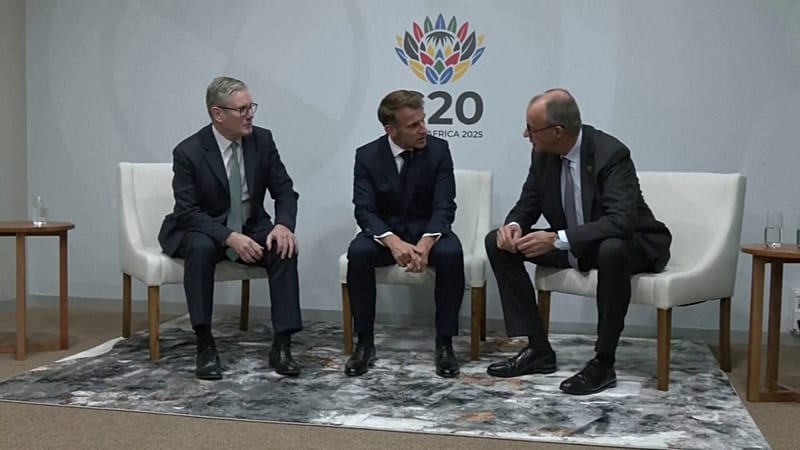
The statement was signed by several key European figures, including the German Chancellor, the UK Prime Minister, and the French President. They voiced their apprehensions about potential reductions in Ukraine’s military strength, which they believe should be preserved rather than diminished. Additionally, they stressed that any elements related to the European Union and NATO must gain the approval of member states before being implemented.

“We are concerned by the proposed limitations on Ukraine’s armed forces,” the statement read. “We also reiterate that the implementation of elements relating to the European Union and relating to NATO would need the consent of EU and NATO members respectively.”
This joint declaration was endorsed by a wide range of European leaders, including EU Council President Costa, President von der Leyen, Canadian Prime Minister Carney, Finland’s President Stubb, President Macron, German Chancellor Merz, Prime Minister Martin, Italian Prime Minister Meloni, Japanese Prime Minister Takaichi, Dutch Prime Minister Schoof, Prime Minister Støre, Prime Minister Sánchez, UK Prime Minister Starmer, and Poland’s Donald Tusk.
A Crucial Week for Ukraine and Europe
Europe and its allies are currently engaged in critical meetings during the G20 summit in South Africa, aiming to prevent Ukraine from being forced into a hasty deal that could leave it vulnerable to future aggression. According to an EU official speaking to Euronews, there is an intense diplomatic effort underway before the U.S.-imposed deadline for Ukraine to accept or reject the 28-point plan.
The same official noted that the pressure on Kyiv is “enormous.” A coalition of countries supporting Ukraine, led by France and the United Kingdom, is set to present an alternative plan. The Europeans’ primary concerns revolve around three main issues: sovereignty, territorial integrity, and Russia’s war reparations.
The statement published on Saturday explicitly states that borders cannot be altered by force, a direct response to the U.S. plan that calls for significant territorial concessions from Ukraine, including the loss of Crimea, Luhansk, and Donetsk to Russia. Furthermore, the leaders emphasized their rejection of reducing Ukraine’s military capacity, which contradicts the U.S. proposal to reduce the number of troops from approximately 900,000 to 600,000.
Both Europeans and Ukrainians agree that Ukraine’s armed forces should be strengthened and expanded to deter future aggression. However, there is a divergence in opinion regarding the handling of frozen Russian assets, primarily held in Europe.
Disputes Over Frozen Assets
The EU is exploring ways to utilize 140 billion euros in immobilized Russian assets held in Belgium to provide an unprecedented reparations loan for Ukraine, covering its military and budget needs for 2026 and 2027. In contrast, the U.S. plan suggests unblocking these assets and placing them in two investment funds—one for Ukraine and another for Russia.
According to a European official who spoke to Euronews under the condition of anonymity, this approach is seen as “surprising to see that level of economic brutality.” For Europe, keeping the assets frozen under its jurisdiction serves as a powerful tool.
The challenge for European leaders is to present an alternative plan without provoking the ire of former President Donald Trump, who advocates for a swift deal. “This is the most difficult hour,” the diplomat remarked.
Zelenskyy’s Warning to Ukrainians
In a video address to Ukrainians, President Zelenskyy highlighted the difficult choice facing the country: either lose its dignity or risk losing the support of the United States. His message underscores the high stakes involved in the ongoing negotiations and the delicate balance between maintaining national sovereignty and securing international backing.